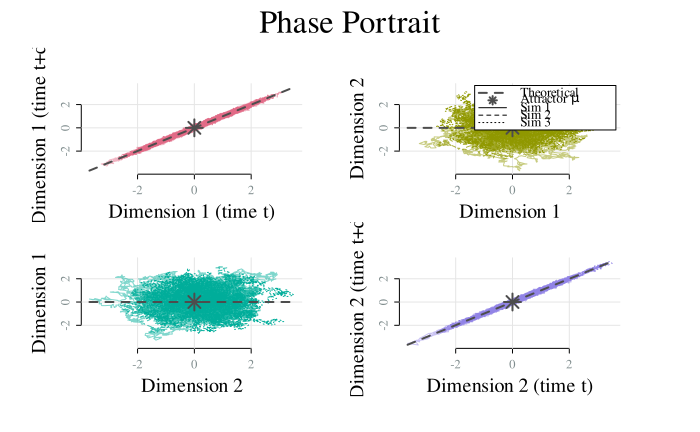
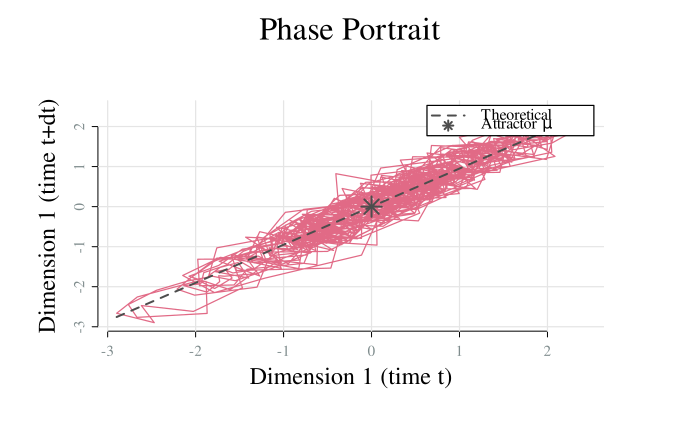
Visualise the phase portrait of an OU affect simulation. In the case of a 1D simulation, this plots the lag-1 phase portrait (i.e., dimension at time t vs. dimension at time t+dt). In the case of multi-dimensional simulations, this creates a grid of panels: diagonal panels show lag-1 phase portraits for each dimension, while off-diagonal panels show contemporaneous scatter plots between pairs of dimensions.
Usage
ou_plot_phase(
  x,
  which_dim = NULL,
  which_sim = NULL,
  share_xaxis = TRUE,
  share_yaxis = TRUE,
  palette = "Dark 3",
  col_theory = "grey30",
  lwd = ifelse(x[["nsim"]] > 1, 1, 1.25),
  alpha = 1,
  main = "Phase Portrait",
  sub = paste("Dimension", if (is.null(which_dim)) {

    seq.int(x[["model"]][["ndim"]])
 } else {
     which_dim
 }),
  xlab = "",
  ylab = "",
  legend_position = "topright",
  ...
)
Arguments
- x
A
simulate_affectOUmodel object produced bysimulate.affectOU()- which_dim
Dimension indices to plot (NULL for all)
- which_sim
Simulation indices to plot (NULL for all)
Logical; use same x-axis limits for all panels?
Logical; use same y-axis limits for all panels?
- palette
Color palette. Should be one of
grDevices::hcl.pals().- col_theory
Color for theoretical relationship line
- lwd
Line width
- alpha
Alpha transparency for colors (0 = transparent, 1 = opaque)
- main
Main title
- sub
Subtitle for panels
- xlab
X-axis label
- ylab
Y-axis label
- legend_position
Position of legend (one of
"bottomright","bottom","bottomleft","left","topleft","top","topright","right","center","none"). Set to"none"to hide legend.- ...
Additional graphical parameters
Diagonal panels (lag-1 phase portrait)
The diagonal panels plot \(X_i(t)\) against \(X_i(t + \Delta t)\), showing the relationship between the current and next value of each dimension. When the system is stable (\(\theta_{ii} > 0\)), the conditional expectation is: $$E[X_i(t + \Delta t) \mid X_i(t) = x] = \mu_i + (x - \mu_i)e^{-\theta_{ii} \Delta t}$$
This is a line through \((\mu_i, \mu_i)\) with slope \(e^{-\theta_{ii} \Delta t} < 1\). The slope being less than 1 reflects mean reversion: values above \(\mu_i\) are expected to decrease; values below \(\mu_i\) are expected to increase. The star marks the attractor point \((\mu_i, \mu_i)\). The theoretical line is only drawn when the system is stable.
Off-diagonal panels (contemporaneous scatter)
The off-diagonal panels plot \(X_i(t)\) against \(X_j(t)\) at the same time point, showing the joint distribution of dimensions \(i\) and \(j\). When the system is stable, the conditional expectation based on the stationary covariance \(\Sigma_\infty\) is: $$E[X_j \mid X_i = x] = \mu_j + \frac{\Sigma_{\infty,ij}}{\Sigma_{\infty,ii}}(x - \mu_i)$$
This is a regression line through \((\mu_i, \mu_j)\) with slope determined by the stationary covariance structure. The theoretical line is only drawn when the system is stable.