Affect characteristics implied by the OU process
Source:vignettes/characteristics.Rmd
characteristics.RmdModelling affect with the Ornstein-Uhlenbeck (OU) process implies
affect dynamics are characterized by several distinct features. This
vignette demonstrates each feature visually. For further mathematical
definitions of the quantities shown here, see stability()
and stationary().
For reference, the multivariate OU process is defined as:
\[d\mathbf{X}(t) = \mathbf{\Theta}(\mathbf{\mu} - \mathbf{X}(t))dt + \mathbf{\Gamma} \, d\mathbf{W}(t)\]
where \(\mathbf{\mu}\) defines the location of the affective baseline, \(\mathbf{\Theta}\) defines the regulation towards this baseline (for stable systems), and \(\mathbf{\Gamma}\) defines the reactivity to random perturbations.
1. Mean Reversion
The first main feature of the OU as a model of affect dynamics concerns the tendency to return to its mean. For stable systems (see later sections), when affect is perturbed, it returns toward its baseline \(\mathbf{\mu}\) at a rate determined by the eigenvalues of \(\mathbf{\Theta}\). In unidimensional systems, \(\theta\) can simply be interpreted as the speed of emotional regulation, where low \(\theta\) represents emotional inertia.
Show mathematical background
It can be proven that this regulation is captured by a matrix exponential so that, after a time step \(\Delta t\), the deterministic drift of the system can be described by the following equation:
\[\begin{equation} \mathbf{X}_{t + \Delta t} = (\mathbf{I}_d - e^{-\mathbf{\Theta} \Delta t}) \mathbf{\mu} + e^{-\mathbf{\Theta} \Delta t} \mathbf{X}_t \end{equation}\]
The rate of this regulation is determined by the eigenvalues of \(\mathbf{\Theta}\). Decomposing:
\[\begin{equation} \mathbf{\Theta} = \mathbf{\Omega} \mathbf{\Lambda} \mathbf{\Omega}^{-1} \end{equation}\]
where \(\mathbf{\Omega}\) contains the eigenvectors and \(\mathbf{\Lambda}\) contains the eigenvalues of the drift matrix \(\mathbf{\Theta}\). The drift can itself be decomposed as:
\[\begin{equation} \begin{split} e^{-\mathbf{\Theta} \Delta t} &= e^{-\mathbf{\Omega} \mathbf{\Lambda} \mathbf{\Omega}^{-1} \Delta t} \\ &= \mathbf{\Omega} e^{-\mathbf{\Lambda} \Delta t} \mathbf{\Omega}^{-1} \end{split} \end{equation}\]
This derivation shows that the rate of the regulation is determined by the eigenvalues \(\mathbf{\Lambda}\) while the directionality of the regulation is determined by the eigenvectors \(\mathbf{\Omega}\). For stable systems with positive real parts to the eigenvalues, higher values of \(\lambda_i \in \mathbf{\Lambda}\) will lead to a more rapid regulation while lower values of \(\lambda_i\) indicate slower regulation.
This property is shown below, in which we simulate two independent OU processes only differing in \(\theta\). The process with higher \(\theta\) (red) stays closer to its attractor (horizontal line, \(\mu\)) than the process with lower \(\theta\) (green), which strays further away. In emotion terms, the former process displays lower affective inertia than the latter..
Show code
# For simplicity and ease of visualisation, we specify both processes in the same model.
# However, as they are uncoupled, they will evolve independently over time.
model <- affectOU(
  theta = diag(c(5.0, 0.5))
)

# Simulate and plot timeseries
sim <- simulate(
  model,
  seed = 123,
  stop = 20
)

plot(
  sim,
  by_dim = FALSE,
  main = "Mean Reversion Depends on θ",
  sub = c("Fast Regulation (θ = 5.0)", "Slow Regulation (θ = 0.5)")
)![Time series plot with two lines, one for each process that is displayed. The fast-regulating process (red, with θ = 5.0) is shown to fluctuate closely around the attractor, typically remaining within the bounds [-1, 1]. The slow-regulating process (green, with θ = 0.5), however, fluctuates more widely around the attractor, with small perturbations building up to large fluctuations around the attractor state.](characteristics_files/figure-html/mean-reversion-plot-1.svg)
2. Perturbation Persistence
After affect is perturbed, it takes time to return to its baseline. The speed of this return is determined by \(\mathbf{\Theta}\), which characterizes how long the effect of perturbations persists. The rate of decay \(\tau\) – sometimes referred to as the relaxation time – can be computed through the solution of the OU, specifically:
\[\begin{equation} \mathbf{y}_{\Delta t} = \mathbf{\mu} + e^{-\mathbf{\Theta} \Delta t} (\mathbf{y}_0 - \mathbf{\mu}) \end{equation}\]
We can then define the relaxation time \(\tau\) as the time \(\Delta t\) after which the initial condition \(\mathbf{y}_0\) relaxed towards the attractor \(\mathbf{\mu}\), retaining only a particular percentage of its original value. For example, for unidimensional OUs, setting the relaxation time \(\tau = \theta^{-1}\) leads to the deviation of initial condition from the attractor (\(\mathbf{y}_0 - \mathbf{\mu}\)) to shrink to \(e^{-1} \approx 0.37 = 37\%\) of its original value.
Show mathematical background
Note that through this set of equations, we can alternatively define the half-life \(\tau = t_{.50} = \ln(2) \mathbf{\Theta^{-1}}\) as the time after which a deviation from \(\mathbf{\mu}\) shrinks to 50%.
The relaxation time is straightforward to compute for unidimensional OUs. To derive this, we can use the solution of the OU, which is given by:
\[\begin{equation} y_{\Delta t} = \mu + e^{-\theta \Delta t} (y_0 - \mu) \end{equation}\]
where \(y_{\Delta t}\) represents the value of the variable after a time step \(\Delta t\), \(y_0\) represents the initial condition, \(\theta\) is the drift parameter, and \(\mu\) is the attractor. Now, we are interested in finding out to what degree the initial deviation from the attractor determines the value of \(y_{\Delta t}\) after a particular time \(\tau\) has passed. In other words, in this solution, we are only interested in the last part of the solution scaling the initial deviation from the attractor:
\[\begin{equation} e^{-\theta \Delta t} (y_0 - \mu) \end{equation}\]
If we denote the relaxation percentage with \(r \in [0, 1]\), then we can compute the corresponding relaxation time \(\tau\) as follows:
\[\begin{equation} \begin{split} e^{-\theta \tau} &= r \\ -\theta \tau &= \ln(r) \\ \tau &= -\ln(r) \theta^{-1} \end{split} \end{equation}\]
Exemplifying this equation with a unidimensional OU with drift coefficient \(\theta = 2\), we can compute its half-time \(\tau = t_{0.5}\) as \(\tau = -\ln(0.5) 2^{-1} = -\frac{\ln(0.5)}{2} \approx 0.35\).
The same logic extends to multivariate OUs, where if we assume the exponential and the logarithm of the drift matrix \(\mathbf{\Theta}\) exist, and if we assume a \(d \times d\) matrix of relaxation percentages \(R\) for which the logarithm exists, then the corresponding relaxation times \(\tau\) can be computed as:
\[\begin{equation} \begin{split} e^{-\mathbf{\Theta} \tau} &= R \\ -\mathbf{\Theta} \tau &= \ln(R) \\ \tau &= -\mathbf{\Theta}^{-1} \ln(R) \end{split} \end{equation}\]
Note that, in this case, \(\tau\) is a \(d \times d\) matrix containing the relaxation times for each dimension separately. One may use the same interpretation of relaxation times as before in cases where the variables captured by the OU are independent (i.e., when \(\mathbf{\Theta}\) is diagonal), in which case \(\tau\) would be a diagonal matrix containing the relaxation times per dimension separately. However, this same principle does not apply to coupled multivariate OUs. Coupling between variables means that the relaxation of one variable can affect the relaxation of others. In this case, the relaxation time of one variable cannot be interpreted separately from the relaxation times of the other variables.
model <- affectOU(theta = 0.5, mu = 0, sigma = 1)Show code
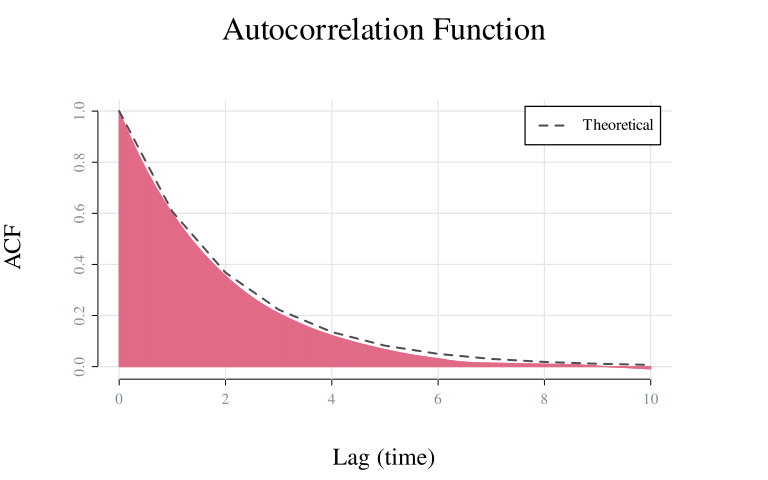
The ACF equals \(1/e\) at the relaxation time and \(0.5\) at the half-life. Slow regulation (i.e., lower \(\theta\)) means longer persistence and higher autocorrelation.
3. Reactivity
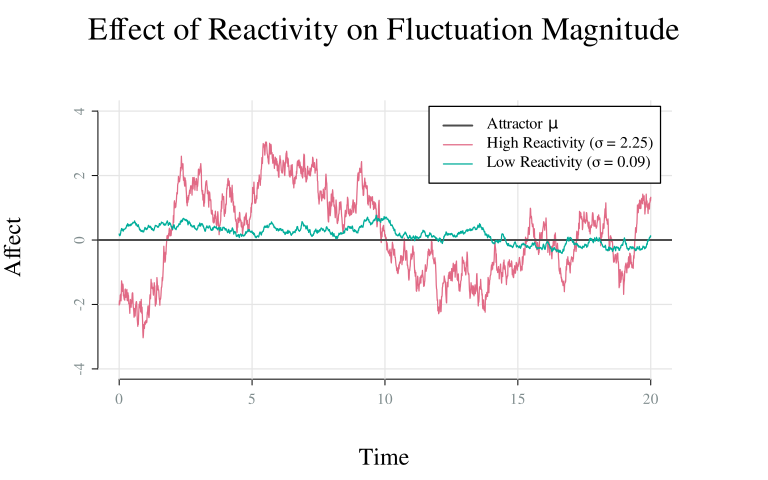
The noise covariance \(\mathbf{\Sigma}\) determines the stochastic
part of affect, and is often interpreted as affective reactivity to
environmental fluctuations. Within affectOU(), you can
either specify the covariance matrix \(\mathbf{\Sigma}\) or the diffusion matrix
\(\mathbf{\Gamma}\), where \(\mathbf{\Gamma}\) must be a lower
triangular matrix. The noise covariance \(\mathbf{\Sigma}\) is the more intuitive
parameter to specify when defining the reactivity of the system, as it
directly captures the variance and covariance of the noise across
dimensions.
Show mathematical background
In our implementation of the OU, the noise term is defined as \(\mathbf{\Gamma} \, d\mathbf{W}(t)\), where \(\mathbf{\Gamma}\) is the diffusion matrix and \(d\mathbf{W}(t)\) is a vector of independent Wiener processes. This means that the noise covariance \(\mathbf{\Sigma}\) is not directly specified but is rather derived from \(\mathbf{\Gamma}\).
The noise covariance \(\mathbf{\Sigma}\) is related to the diffusion matrix \(\mathbf{\Gamma}\) through:
\[\begin{equation} \mathbf{\Sigma} = \mathbf{\Gamma} \mathbf{\Gamma}^T \end{equation}\]
This equality is known as the Cholesky decomposition, requiring the diffusion matrix \(\mathbf{\Gamma}\) to be a lower triangular matrix. This restriction ensures that we may convert between \(\mathbf{\Sigma}\) and \(\mathbf{\Gamma}\) without loss of generality, meaning that any positive semi-definite covariance matrix \(\mathbf{\Sigma}\) can be represented through \(\mathbf{\Gamma}\).
In the figure shown below, we visualize how two processes that are subject to the same perturbations may show larger fluctuations based on their value of the variance \(\sigma\), where higher \(\sigma\) leads to greater fluctuations around the attractor. In emotion terms, the former process is more emotionally reactive to environmental fluctuations than the latter.
Show code
# For simplicity and ease of visualisation, we specify both processes in the same model.
# However, as they are uncoupled, they will evolve independently over time.
model <- affectOU(theta = 0.5, mu = 0, sigma = diag(c(2.25, 0.09)))
sim <- simulate(model, seed = 456, stop = 20)
plot(sim,
  by_dim = FALSE,
  sub = c("High Reactivity (σ = 2.25)", "Low Reactivity (σ = 0.09)"),
  main = "Effect of Reactivity on Fluctuation Magnitude", ylim = c(-4, 4)
)
4. Multivariate Coupling
In multivariate models, off-diagonal elements of \(\mathbf{\Theta}\) allow for coupling between dimensions, meaning that the dynamics of two variables can be interlinked. For example, we can create a coupled two-dimensional system with:
<!– \[\mathbf{\Theta} = \begin{bmatrix} \theta_{11} & \theta_{12} \\ \theta_{21} & \theta_{22} \end{bmatrix} = \begin{bmatrix} 0.5 & 0.0 \\ -2.0 & 0.5 \end{bmatrix}\]
The following figure illustrates the resulting coupled dynamics.
Show background on eigenvalues and eigenvectors
\(\mathbf{\Theta}\) is multiplied by the current state \(\mathbf{X}(t)\) to determine the deterministic drift of the system. For example, in a two-dimensional system without any diffusion (i.e., \(\mathbf{\Gamma} = 0\)), the change in \(\mathbf{x}\) is given by:
\[\frac{d\mathbf{x}}{dt} = \mathbf{\Theta} (\mathbf{\mu} - \mathbf{x}) = \begin{bmatrix} \theta_{11} & \theta_{12} \\ \theta_{21} & \theta_{22} \end{bmatrix} \begin{bmatrix} \mu_1 - x_1 \\ \mu_2 - x_2 \end{bmatrix} = \begin{bmatrix} \theta_{11} (\mu_1 - x_1) + \theta_{12} (\mu_2 - x_2) \\ \theta_{21} (\mu_1 - x_1) + \theta_{22} (\mu_2 - x_2) \end{bmatrix}\]
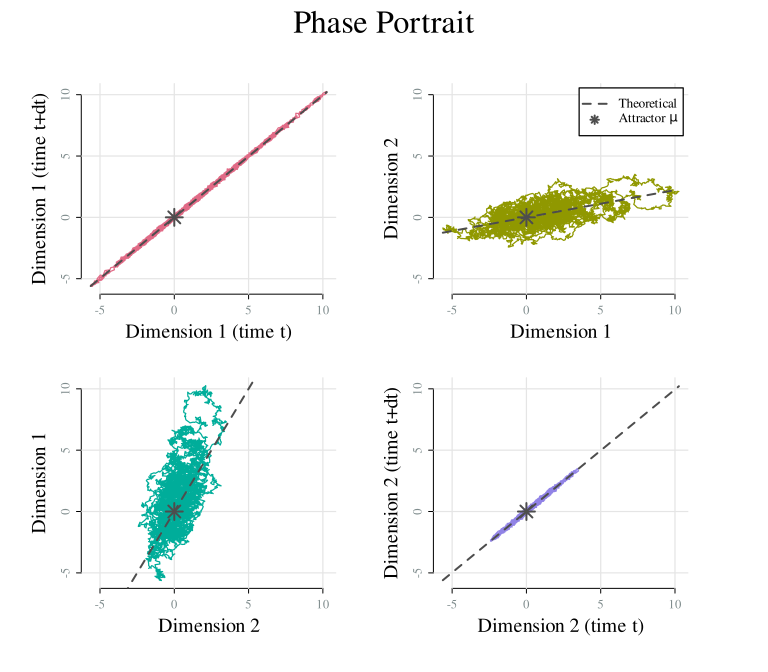
The change in each dimension \(i\) is determined by both its own deviation from \(\mathbf{\mu}\) and the deviation of the other dimension, weighted by the corresponding elements of \(\mathbf{\Theta}{i\cdot}\). This means that the dynamics of one dimension can influence the dynamics of the other dimension, creating coupled trajectories. For example, as shown below, a negative entry \(\theta_{12}\) means that when dimension 2 is above its attractor, it pushes dimension 1 up, and when dimension 2 is below its attractor, it pushes dimension 1 down.
Interdimensional coupling can also be analyzed using an eigendecomposition. The eigenvectors \(\mathbf{\Omega}\) shape the direction along which the system moves towards its attractor \(\mathbf{\mu}\) (in case of a stable system). The eigenvectors of \(\mathbf{\Theta}\) are:
\[\mathbf{\Omega} \approx \begin{bmatrix} 1 & 1 \\ 0 & 0 \end{bmatrix}\]
Each column of \(\mathbf{\Omega}\) represents an eigenvector, which is a direction in the state space along which the system moves towards its attractor. The matrix is defective, with only one linearly independent eigenvector. The system is effectively one-dimensional, with both dimensions moving together along the same trajectory toward the attractor. This behaviour is similarly visible in the time-series plot below, where both dimensions evolve in an almost identical way over time.
Show code
# theta_12 = -2: when dimension 2 is above its attractor, it pushes dimension 1 up;
# when dimension 2 is below its attractor, it pushes dimension 1 down
theta_2d <- matrix(c(
  0.5, -2,
  0, 0.5
), nrow = 2, byrow = TRUE)

# eigen(theta_2d)

model_2d <- affectOU(theta = theta_2d, mu = 0, gamma = 1)
sim_2d <- simulate(model_2d)
plot(sim_2d, main = "Coupled Trajectories", xlim = c(0, 20))
plot(sim_2d, type = "phase", main = "Phase Portrait")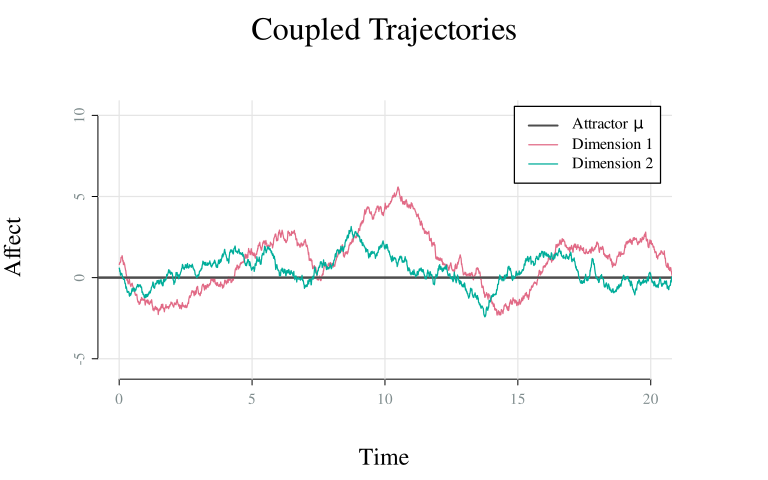
5. Stability Regimes
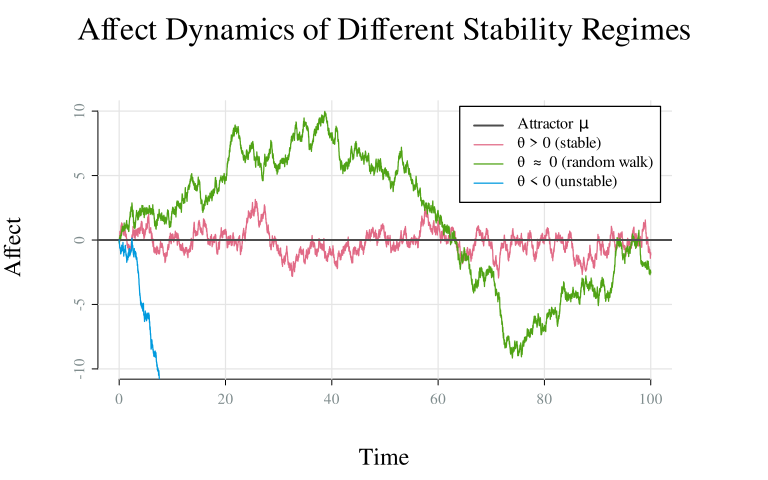
Stability refers to the long-run qualitative behaviour of the system. For the OU process, stability concerns whether the system will be regulated towards the attractor \(\mathbf{\mu}\) and, if so, in what way. This behaviour depends largely on the drift matrix \(\mathbf{\Theta}\).
Univariate
In the univariate case, the sign of \(\theta\) determines the qualitative behaviour of the system. Three regimes can be distinguished:
- \(\theta > 0\): Stable, mean-reverting around \(\mu\);
- \(\theta \approx 0\): Random walk without clear attractor, meaning the process drifts without returning to its baseline;
- \(\theta < 0\): Unstable process that diverges from \(\mu\).
Show code
# For simplicity and ease of visualisation, we specify all processes in the same model.
# However, as they are uncoupled, they will evolve independently over time.
model <- affectOU(theta = diag(c(0.5, 0.01, -0.3)))
sim <- simulate(model, stop = 100, seed = 43)
#> Warning: ! System is not stable; no stationary distribution exists.
#> ℹ Defaulting `initial_state` to mu.
plot(sim,
  ylim = c(-10, 10), by_dim = FALSE,
  main = "Affect Dynamics of Different Stability Regimes",
  sub = c("θ > 0 (stable)", "θ ≈ 0 (random walk)", "θ < 0 (unstable)")
)
Multivariate
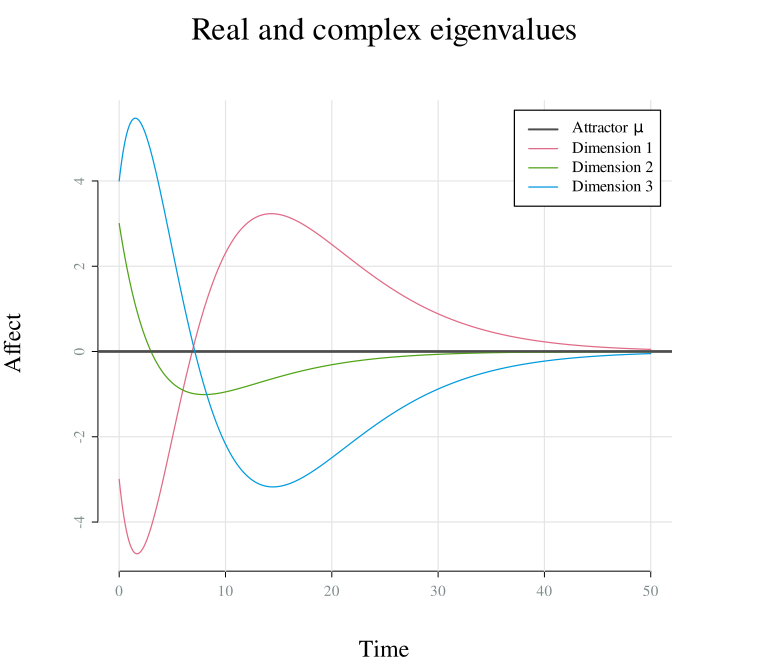
For multiple dimensions, stability depends on the eigenvalues of \(\mathbf{\Theta}\). We distinguish three cases:
- Real positive eigenvalues: In this case, the OU shows smooth exponential decay toward the attractor \(\mathbf{\mu}\) for all variables;
- Complex eigenvalues with positive real parts: In this case, the OU will display damped linear oscillations around the attractor \(\mathbf{\mu}\) for all variables, representing cyclical affect patterns;
- Eigenvalue with zero or negative real parts: In this case, the OU is non-stationary, meaning that affect will diverge over time – either drifting monotonically or oscillating with growing amplitude, depending on whether the eigenvalues are real or complex. This type of behaviour is usually not of theoretical interest.
Below, we demonstrate the first two cases, setting the noise covariance \(\mathbf{\Sigma}\) to zero to better show the dynamics implied by the eigenvalues.
Show code
# Real eigenvalues: Smooth decay
theta_real <- matrix(
  c(0.2, 0.1, 0.1, 0.2),
  nrow = 2
)

eigen(theta_real)$values
#> [1] 0.3 0.1

# Complex eigenvalues: Oscillatory decay
theta_complex <- matrix(
  c(0.2, -1, 1, 0.2),
  nrow = 2
)

eigen(theta_complex)$values
#> [1] 0.2+1i 0.2-1i
# Define the two models
model_real <- affectOU(
  theta = theta_real,
  sigma = 0
)

model_complex <- affectOU(
  theta = theta_complex,
  sigma = 0
)

# Perform simulations for both systems
seed <- 123
sim_real <- simulate(
  model_real,
  stop = 50, seed = seed,
  initial_state = c(-3, 3)
)

sim_complex <- simulate(
  model_complex,
  stop = 50, seed = seed,
  initial_state = c(-3, 3)
)

# Plot the resulting time-series
plot(sim_real, main = "Real eigenvalues")
plot(sim_complex, main = "Complex eigenvalues")![Visualization of the two types of behavior expected in two separate plot panes. Each plot consists of two smooth lines displaying the expected behavior according to the model. In the left plot, the two lines start out at the intercepts [-3, 3] and then decay exponentially towards the attractor $\mu = (0, 0)$. In the right plot, the two lines start at at the same intercepts [-3, 3] but then oscillate around the attractor $\mu = (0, 0)$. These oscillations are damped so that they initially start out big, but die down after a while.](characteristics_files/figure-html/regimes-2d-plot-1.svg)
![Visualization of the two types of behavior expected in two separate plot panes. Each plot consists of two smooth lines displaying the expected behavior according to the model. In the left plot, the two lines start out at the intercepts [-3, 3] and then decay exponentially towards the attractor $\mu = (0, 0)$. In the right plot, the two lines start at at the same intercepts [-3, 3] but then oscillate around the attractor $\mu = (0, 0)$. These oscillations are damped so that they initially start out big, but die down after a while.](characteristics_files/figure-html/regimes-2d-plot-2.svg)
Note that the behaviour of the OU may also represent a mix of these two types, combining exponential decay with oscillatory patterns. This is for example the case in the following figure:
Show code
6. Noise Coupling
Non-zero off-diagonal elements of \(\mathbf{\Gamma}\) mean that the same random fluctuations drive both dimensions simultaneously — the noise sources are shared. This can lead to synchronized fluctuations even when there is no coupling in the deterministic part of the process (i.e., \(\mathbf{\Theta}\) is diagonal).
Show code
# Shared noise sources (same fluctuation drives both dims), no drift coupling
gamma_2d <- matrix(c(
  1, 0,
  0.5, 1
), nrow = 2, byrow = TRUE)
gamma_2d %*% t(gamma_2d)  # implied noise covariance Σ

model_2d <- affectOU(theta = 0.5, mu = 0, gamma = gamma_2d)
sim_2d <- simulate(model_2d, seed = 105)
plot(sim_2d, main = "Shared Noise Sources", xlim = c(0, 20))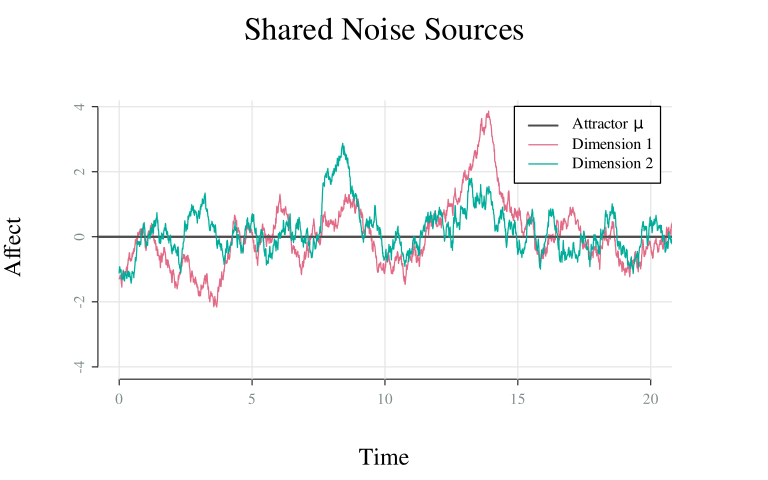
Summary
| Feature | Parameter | Effect |
|---|---|---|
| Mean reversion | \(\mathbf{\Theta}\) | Rate and direction of return to baseline |
| Relaxation time | \(\mathbf{\Theta}\) | Perturbation persistence |
| Reactivity | \(\mathbf{\Sigma}\) | Magnitude of response to perturbations |
| Dimensional Coupling | Eigenvectors of \(\mathbf{\Theta}\) | Coupled dynamics |
| Stability | Eigenvalues of \(\mathbf{\Theta}\) | Stationary vs divergent |
| Noise coupling | Off-diagonal elements of \(\mathbf{\Sigma}\) | Shared noise sources across dimensions |