The aim of affectOU is to provide tools for simulating the Ornstein-Uhlenbeck (OU) process in R. The OU is widely used to model affect dynamics: how feelings or emotions change over time (e.g., Guthier et al., 2020; Kuppens et al., 2010a; Voelkle & Oud, 2013). It formulates three core psychological mechanisms through three sets of parameters (Uhlenbeck & Ornstein, 1930; Oravecz et al., 2011):
- Drift matrix Θ: Governs the rate at which affect returns to baseline, capturing a person’s emotion regulation capacity or emotional inertia;
- Attractor μ: The long-term average level of affect that the system tends to return to, representing a person’s baseline mood or emotional setpoint;
- Diffusion matrix Γ: Controls the magnitude of short-term fluctuations or noise in the affective system, characterizing an individual’s reactivity or sensitivity to environmental perturbations.
affectOU primarily serves as a demonstration of a packaged computational model, as detailed in Evers & Vanhasbroeck (2026), “Sharing Computational Models as Reproducible and User-Friendly Packages: A Tutorial in R” (forthcoming).
Installation
affectOU can be installed from GitHub with:
# install.packages("pak")
pak::pak("KCEvers/affectOU")
Once installed, one can use the package through calling the library() function.
Quick Start
The core functionality of the package revolves around an OU model object created by the function affectOU(). For example, the following creates a two-dimensional model with default parameter values:
model <- affectOU(ndim = 2)
print(model)
#>
#> ── 2D Ornstein-Uhlenbeck Model ─────────────────────────────────────────────────
#> dX(t) = Θ(μ − X(t))dt + Γ dW(t)
#>
#> μ = [0.000, 0.000]
#>
#> Θ:
#>      [,1] [,2]
#> [1,]  0.5  0.0
#> [2,]  0.0  0.5
#>
#> Γ:
#>      [,1] [,2]
#> [1,]    1    0
#> [2,]    0    1
#>
#> Σ = ΓΓᵀ:
#>      [,1] [,2]
#> [1,]    1    0
#> [2,]    0    1
summary(model)
#>
#> ── 2D Ornstein-Uhlenbeck Model ─────────────────────────────────────────────────
#>
#> ── Dynamics ──
#>
#> Stable (node)
#>
#> ── Stationary distribution ──
#>
#> Mean: [0, 0]
#> SD: [1, 1]
#>
#> ── Structure ──
#>
#> Coupling: none
#> Noise: independent
The model can then be simulated with simulate() and visualised over time with plot().
sim <- simulate(model)
plot(sim)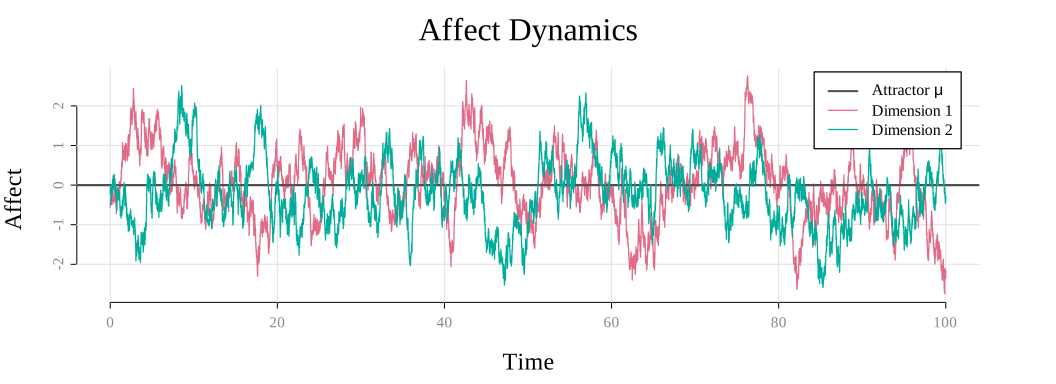
Explore the OU Process
For more detailed examples and visual demonstrations of the model’s characteristics, see the vignettes:
More ways to visualise the OU are offered in plot(). Its theoretical properties are further explained in the function documentation of stability() and stationary(). For fitting unidimensional OU models to data, see fit().
References
Evers, K. C. & Vanhasbroeck, N. (2026). Sharing computational models as reproducible and user-friendly packages: A tutorial in R. Manuscript in preparation.
Guthier, C., Dormann, C., & Voelkle, M. C. (2020). Reciprocal effects between job stressors and burnout: A continuous-time meta-analysis of longitudinal studies. Psychological Bulletin, 146, 1146-1173. doi: 10.1037/bul0000304
Kuppens, P., Oravecz, Z., & Tuerlinckx, F. (2010). Feelings change: Accounting for individual differences in the temporal dynamics of affect. Journal of Personality and Social Psychology, 99, 1042-1060. doi: 10.1037/a0020962
Oravecz, Z., Tuerlinckx, F., & Vandekerckhove, J. (2011). A hierarchical latent stochastic differential equation model for affective dynamics. Psychological Methods, 16, 468-490. doi: 10.1037/a0024375
Uhlenbeck, G. E. & Ornstein, L. S. (1930). On the theory of Brownian motion. Physical Review, 46, 823-841.
Voelkle, M. C. & Oud, J. H. L. (2013). Continuous time modelling with individually varying time intervals for oscillating and non-oscillating processes. British Journal of Mathematical and Statistical Psychology, 66, 103-126. doi: 10.1111/j.2044-8317.2012.02043.x